
BHAG: Big, Hairy, Audacious Goal
A Big, Hairy, Audacious Goal (commonly abbreviated to BHAG and pronounced ‘bee-hag’) is a long-term strategic goal that is bold, compelling, and ambitious to the point of being daunting.

What it is
A Big, Hairy, Audacious Goal (commonly abbreviated to BHAG and pronounced ‘bee-hag’) is a long-term strategic goal that is bold, compelling, and ambitious to the point of being daunting. Unlike incremental targets or conventional five-year plans, a BHAG is designed to galvanise an entire organisation, demanding a fundamental shift in how it thinks and operates. It is not a mission statement or a quarterly KPI. It is a singular, vivid destination that might take ten to thirty years to reach, but that provides clear and unambiguous direction for every strategic decision made along the way.
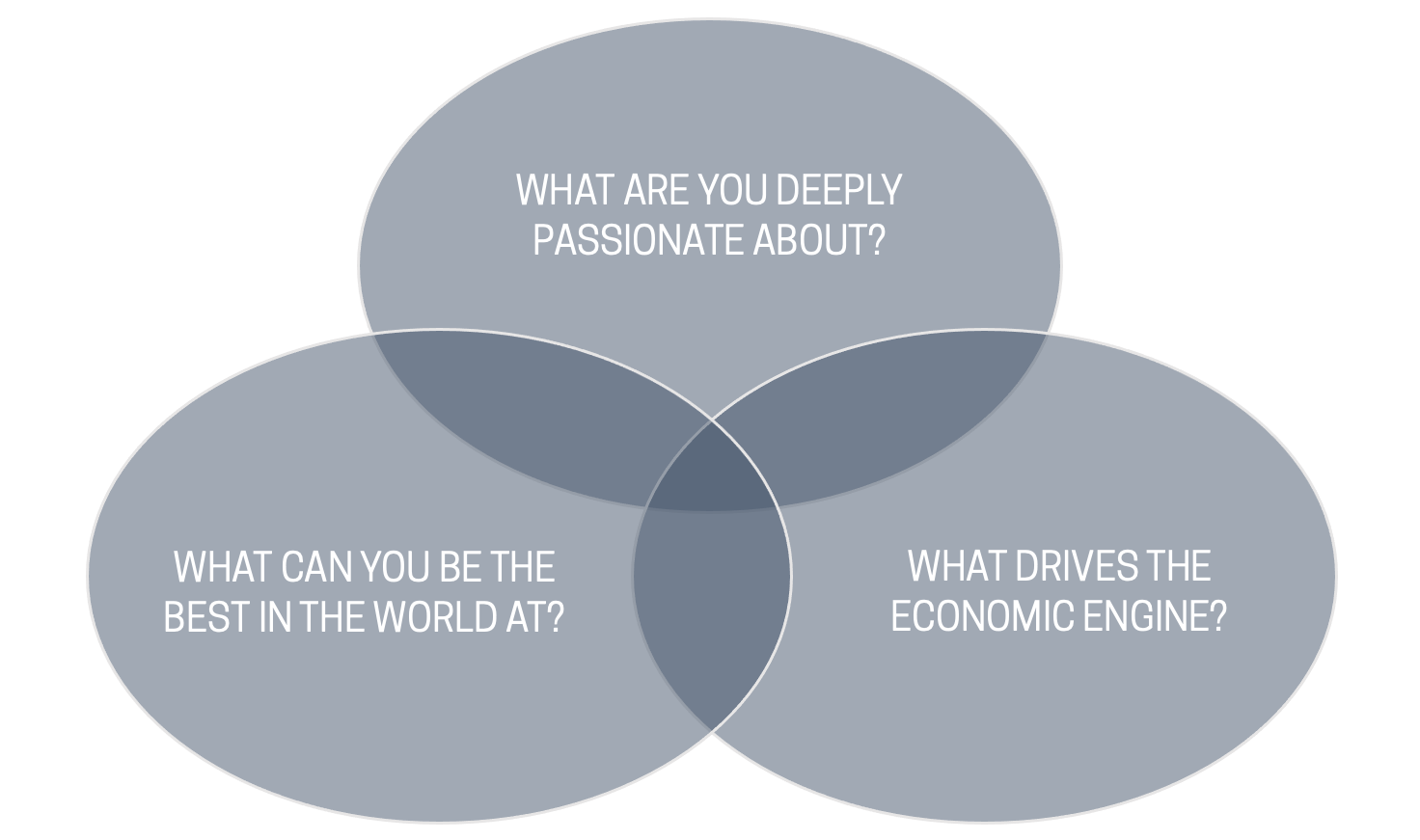
A well-formed BHAG has four defining characteristics. First, it is clear and compelling enough for anyone in the organisation to understand without further explanation. Second, it connects deeply to the organisation’s core purpose and values. Third, it sits at the intersection of what the organisation is passionate about, what it can be the best in the world at, and what drives its economic engine - a construct drawn from Jim Collins’s Hedgehog Concept. Fourth, it is not certain of achievement. A true BHAG carries a meaningful probability of failure, which is precisely what makes it energising rather than routine.
BHAGs are most commonly associated with Jim Collins and Jerry Porras, who introduced the concept in their landmark 1994 book Built to Last: Successful Habits of Visionary Companies. They identified four broad categories of BHAG: the Target BHAG (a quantitative or qualitative finish line), the Common Enemy BHAG (competing against a specific rival), the Role Model BHAG (emulating an aspirational organisation), and the Internal Transformation BHAG (a goal centred on deep structural change within the organisation itself).
Background
Jim Collins and Jerry Porras developed the BHAG concept as part of a six-year research project at Stanford Graduate School of Business. The study, which formed the basis of Built to Last (1994), examined eighteen visionary companies that had stood the test of time - organisations like General Electric, 3M, Walt Disney, and Merck - and compared them with a matched set of comparable but less exceptional firms. The central question was: what makes truly great companies different?
One of the most striking findings was that visionary companies consistently set goals so ambitious that they initially seemed almost unreachable. Collins and Porras observed that these goals were not derived from market research or a sober analysis of competitive position. They came from a deep belief in the organisation’s potential and a willingness to commit to something before the path to achievement was fully understood.
The most celebrated example in the original research was Boeing’s ambition in the 1950s to become the dominant force in commercial aviation, at a time when the company derived the overwhelming majority of its revenue from military contracts. Another was Wal-Mart founder Sam Walton’s goal, set in 1990, to become a $125 billion company within a decade. The researchers also pointed to what has since become the most iconic BHAG in history: US President John F. Kennedy’s 1961 declaration that America would “put a man on the moon and return him safely to earth” before the decade was out. Although Kennedy was not leading a commercial organisation, the clarity, boldness, and time-boundedness of that goal perfectly captures what Collins and Porras meant.
Collins later revisited and deepened the concept in Good to Great (2001) and Good to Great and the Social Sectors (2005), embedding BHAGs within a broader framework of disciplined people, disciplined thought, and disciplined action. He cautioned, however, that a BHAG divorced from a clear understanding of organisational capabilities - the Hedgehog Concept - risks becoming what he called a ‘BHAG in name only’: an empty slogan that generates cynicism rather than commitment.
When to use it
The BHAG framework is most powerfully applied in the following circumstances:
- Strategic inflection points: when an organisation faces a fundamental shift in its market, technology landscape, or competitive environment and needs a unifying long-term direction to anchor decision-making.
- Periods of organisational stagnation: when incremental improvement targets have failed to inspire genuine energy or ambition, and leadership needs to reset expectations about what the organisation is capable of.
- Vision and strategy refresh cycles: when leadership teams are revisiting their foundational strategic narrative and need a long-term horizon goal to sit above shorter-term planning.
- Leadership transitions: when a new chief executive or leadership team seeks to signal a break from the past and establish a new sense of organisational identity and aspiration.
- Start-up and scale-up contexts: where founders need a rallying purpose that can attract talent, investors, and partners who want to be part of something genuinely significant.
- Merger and acquisition integration: when bringing two distinct cultures together, a new shared BHAG can provide a unifying narrative that transcends legacy loyalties.
It is equally important to understand when not to use the BHAG framework. Organisations in acute financial distress, for example, typically need to focus on near-term survival priorities rather than on decade-long aspirations. Similarly, a BHAG that is imposed top-down without genuine leadership conviction - or that is generated as a branding exercise rather than a genuine strategic commitment - will quickly be recognised as hollow by employees and will do more harm than good.
How to use it
Developing a BHAG is a disciplined, creative process, not a brainstorming exercise. The following steps provide a structured approach:
Step 1: Clarify your core ideology
Before setting a BHAG, leadership must have a clear and honest understanding of the organisation’s core values (what it stands for, regardless of commercial pressures) and its core purpose (its fundamental reason for existing beyond profit). Collins and Porras argue that a BHAG must be consistent with, and expressive of, this core ideology. A goal that contradicts core values will generate internal incoherence and will not sustain commitment over the long term.
Step 2: Apply the Hedgehog Concept
Draw on Collins’s Hedgehog Concept from Good to Great to identify the intersection of three circles: what the organisation can be the best in the world at; what it is deeply passionate about; and what drives its economic engine (or, in not-for-profit contexts, its resource engine). The most powerful BHAGs sit firmly within this intersection. A goal that falls outside it may be exciting, but will lack the organisational capability to sustain progress.
Step 3: Choose your BHAG category
Decide which of the four BHAG types is most appropriate for your context:
- Target BHAG: a clear, quantitative or qualitative outcome (e.g., ‘Become a $10 billion company by 2040’ or ‘Eliminate plastic from all our packaging by 2035’).
- Common Enemy BHAG: orient the organisation against a specific competitor or paradigm it seeks to displace (e.g., Nike’s early goal to ‘Crush Adidas’).
- Role Model BHAG: aspire to become like a respected organisation in a different field (e.g., ‘Become the Amazon of our industry’).
- Internal Transformation BHAG: focus on a fundamental change in the character or capability of the organisation itself (e.g., ‘Transform from a product company to a platform company’).
Step 4: Stress-test for authenticity
Apply three diagnostic tests:
- Is the goal truly bold enough to require a step-change in capability and approach, rather than a continuation of the current trajectory?
- Does it connect viscerally to the organisation’s core purpose, such that people would be excited about working towards it even if it were not tied to their salary?
- Does it have a realistic (if uncertain) path to achievement within the organisation’s Hedgehog concept - meaning that it is not simply fantasy?
Step 5: Express it simply and memorably
A BHAG must be communicable in a single sentence. Leadership teams often fall into the trap of over-qualifying the statement with caveats, sub-clauses, and conditions that drain it of energy. The final articulation should be short enough to remember, vivid enough to visualise, and bold enough to make people feel slightly uncomfortable.
Step 6: Build it into strategy and planning cycles
A BHAG is not a standalone artefact. Once set, it must be connected downward into strategy, planning, and performance management. Medium-term strategic plans (typically three to five-year horizons) should articulate what progress towards the BHAG looks like in that window. Annual operating plans should identify the specific capabilities, investments, and milestones that move the organisation closer. Without this cascading connection, the BHAG becomes a poster on the wall rather than a living strategic commitment.
Frequently asked questions (FAQs)
How is a BHAG different from a vision statement?
A vision statement typically describes the kind of organisation a company aspires to become - its values, culture, and general direction. A BHAG is a specific, time-bound goal. The two are complementary: the vision provides the philosophical context, while the BHAG provides the concrete destination. Collins and Porras describe vision as comprising core ideology (values and purpose) plus an envisioned future, of which the BHAG is the most tangible expression.
Can a small or mid-sized business use a BHAG?
Absolutely. While the examples most frequently cited in the literature involve large corporations or national programmes, the BHAG framework is scale-agnostic. A thirty-person professional services firm can have a BHAG every bit as compelling as a multinational. What matters is that the goal is genuinely ambitious relative to the organisation's current position, and that it is rooted in a realistic (if uncertain) understanding of its potential.
How do we stop a BHAG from becoming a meaningless slogan?
The greatest risk to any BHAG is that leadership sets it but fails to translate it into tangible implications for decision-making, resource allocation, and organisational capability development. The antidote is integration: the BHAG must be referenced consistently in strategic reviews, investment decisions, and leadership communications. It should also be connected to a vivid description of what success looks like - Collins calls this the ‘Vivid Description’ - so that people can visualise the destination, not just recite the goal statement.
Should the BHAG be shared externally with customers and investors?
Many organisations do share their BHAG publicly, and there can be genuine advantages in doing so: it attracts talent who want to be part of something significant, communicates strategic intent to investors, and builds a brand narrative. However, public commitment also raises the stakes around accountability. The decision should be made pragmatically based on the competitive context. If the BHAG reveals proprietary strategic intent that could benefit rivals, it may be wiser to share the purpose and direction without the specific goal.
Related models
 MBA Management Models
 MBA Management Models
 MBA Management Models
Further reading
Collins, J. C. and Porras, J. I. (1994) Built to Last: Successful Habits of Visionary Companies. New York: HarperBusiness.
Collins, J. C. (2001) Good to Great: Why Some Companies Make the Leap … and Others Don’t. New York: HarperBusiness.
Collins, J. C. (2005) Good to Great and the Social Sectors: A Monograph to Accompany Good to Great. Boulder, CO: Jim Collins.
Collins, J. C. and Porras, J. I. (1996) Building Your Company’s Vision. Harvard Business Review, 74(5), pp. 65–77. Available from https://hbr.org/1996/09/building-your-companys-vision
Collins, J. C. (2009) How the Mighty Fall: And Why Some Companies Never Give In. New York: HarperBusiness.
Doerr, J. (2018) Measure What Matters: OKRs - The Simple Idea That Drives 10x Growth. New York: Portfolio/Penguin.
Kaplan, R. S. and Norton, D. P. (1996) The Balanced Scorecard: Translating Strategy into Action. Boston, MA: Harvard Business School Press.
Kim, W. C. and Mauborgne, R. (2005) Blue Ocean Strategy: How to Create Uncontested Market Space and Make the Competition Irrelevant. Boston, MA: Harvard Business School Press.
Kotter, J. P. (1996) Leading Change. Boston, MA: Harvard Business School Press.
Porras, J. I., Emery, S. and Thompson, M. (2007) Success Built to Last: Creating a Life that Matters. Upper Saddle River, NJ: Wharton School Publishing.
Some of the links to products provided in this article are affiliate links. This means that the supplier may pay the owner of this website a small amount of money for purchases made via the link. This will have absolutely no impact on the amount you pay.